

Manual Patient Lifts
Reliable hydraulic liftsNo batteries, no charging
Drive Medical and Invacare hydraulic floor lifts with weight capacities up to 450 lbs. Free shipping in the continental US.
Compare modelsCall 855-272-6335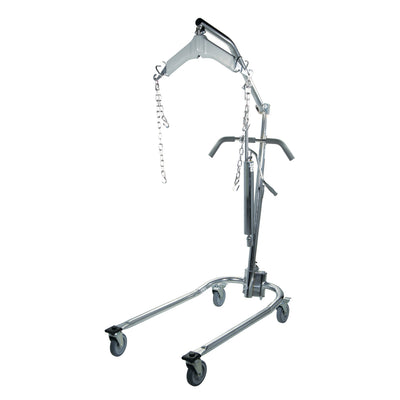

Manual hydraulic lifts are raised with a pump handle and lowered with a release valve. They cost less than power lifts, never need charging, and are very reliable for home use.
Not sure which lift you need? Read our patient lift buying guide or call 855-272-6335.
Hydraulic Patient Lift with Six Point Cradle
- 6-point cradle for easy positioning
- Chrome-plated steel frame
- Adjustable-width base with locking caster brakes
- Sling chains included
Hydraulic Patient Lift with Six Point Cradle by Drive Medical
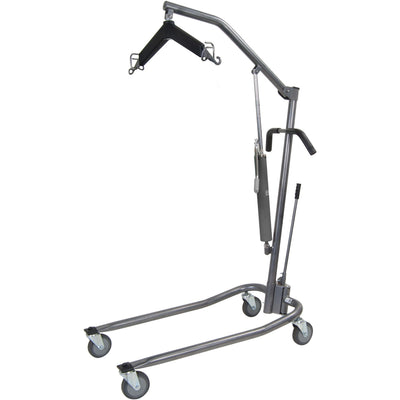
- Silver Vein steel frame
- Base opens from 22.5" to 42"
- 5" casters with easy caster brakes
- Smooth, gradual hydraulic lift
Invacare Reliant 450 Hydraulic Patient Lift
- Maintenance-free hydraulic pump
- Padded swivel bar rotates 360 degrees
- Base legs adjust and lock securely
- Free sling included
Manual Patient Lift Buying Guide
A manual patient lift, often called a hydraulic lift or Hoyer-style lift, lets one caregiver safely move a person who can't stand or bear weight. It lifts them in a sling and moves them between a bed, wheelchair, chair or commode, so nobody has to lift by hand.
Manual lifts are the simplest and most affordable full-body lifts. There is no battery to charge and nothing to plug in, so the lift is always ready, even during a power outage. That makes them a popular choice for home care.
How a manual hydraulic lift works
The caregiver pumps a handle on the mast to raise the boom and lift the person in the sling. To lower them, the caregiver slowly opens a release valve, which lets the boom down gently and under control. The sling hangs from a cradle (also called a spreader bar) at the end of the boom. The base legs roll on casters and spread apart to straddle a wheelchair or chair.
Is a manual lift right for you?
What to compare
- Weight capacity. Every lift on this page holds up to 450 lbs. For larger patients, see our bariatric lifts rated up to 600 lbs.
- Lifting range. The boom height range tells you how low and how high the lift reaches. A higher top height helps with tall hospital beds and higher chairs.
- Cradle style. A 6-point cradle gives you more hook-up points to position the person comfortably in a sitting or reclined posture. A padded swivel bar that turns 360 degrees makes it easy to face the person the right way.
- Base width. Legs that open wide (for example 22.5" closed to 42" open) let the lift get around a wheelchair, recliner or commode. Closed legs make it easier to get through doorways.
- Base height. The legs need open space under the bed. Check the lift's base height and measure the clearance under your bed before you buy.
- Casters and brakes. Larger casters roll more easily on carpet and thresholds, and caster brakes keep the lift in place when it's parked.
Choosing a sling
The sling is what actually holds the person, so choose it as carefully as the lift. A full-body sling works for most bed-to-chair transfers. A U-sling or split-leg sling is easier to put on and take off while the person is seated, and a commode sling has an opening for toileting. Make sure the sling matches your lift's cradle and fits the person's size and weight. Shop our patient lift slings.
Using a patient lift safely
- Read the manufacturer's instructions, and ask a nurse or therapist to show you how to use the lift if you can.
- Check the sling, straps, chains and hooks for wear before every use.
- Lift only as high as you need to clear the bed or chair, and move slowly and smoothly.
- Keep the person centered and facing the mast, and never leave them alone while they are in the sling.
Not sure which lift or sling to pick? Call us at 855-272-6335 and we'll help you choose.
Frequently Asked Questions
Do manual patient lifts need batteries or electricity?
No. A manual lift is raised with a hydraulic pump handle and lowered with a release valve, so there is nothing to charge or plug in. It works anywhere, even during a power outage.
Can one caregiver use a manual lift?
Yes. Patient lifts are designed so one trained caregiver can transfer a person safely. Some facilities and some situations call for two caregivers, so follow the manufacturer's instructions and your care team's advice.
Will a manual lift fit under my bed?
Most floor lifts need a few inches of open space under the bed for the base legs and casters. Check the base height listed on the product page and measure the clearance under your bed before you order.
Is a sling included?
It depends on the lift. The Invacare Reliant 450 comes with a free sling, and the Drive hydraulic lift includes sling chains. Check each product page, and see our patient lift slings if you need one.
Should I get a manual or a power lift?
A manual lift costs less and never needs charging. A power lift raises and lowers at the push of a button, which takes less effort and gives smoother control. If transfers happen many times a day, or the caregiver has back or shoulder problems, a power lift is usually worth it.
Can I pay with an FSA or HSA card?
Yes. We accept FSA and HSA cards at checkout.
Is shipping free?
Yes, shipping is free to the continental United States. Orders to Alaska, Hawaii, US territories and APO addresses pay shipping.